






Skip to content

Automated payments reconciliation software

Reconcile payment data across card networks, processors, acquirers, banks and internal systems in one controlled workflow. AutoRek standardizes incoming data, applies configurable matching rules, surfaces exceptions for investigation and provides clear visibility from transaction through to settlement and reporting.

  • 69%

    of surveyed payments organizations cited manual processes and limited automation as their biggest scalability constraint.

  • 80%

    reported moderate to significant operational impact from fragmented payments data.

  • 24%

    of firms expect payment volume to flow through blockchain-based rails by 2030.

Survey findings from The Future of Payments Operations 2026, based on market research from 250 UK and US respondents interviewed in November 2025.

Payments move quickly. Reconciliation cannot be the control that catches up later

Operational Challenges

Payment firms reconcile activity across multiple rails, providers and stages of the transaction lifecycle. Authorization, clearing, settlement, fees, chargebacks, refunds, and bank movements may be recorded by different parties at different times. When teams rely on spreadsheets, point tools or aging in-house processes, breaks accumulate and investigations start with manual searches across disconnected systems.

Regulatory Challenges

Where payment firms hold or safeguard customer funds, they need clear evidence of where funds are held, how balances are derived, and how discrepancies are managed. Requirements differ by jurisdiction and business model. This page should explain that strong reconciliation supports control, traceability and audit readiness without claiming that use of AutoRek alone guarantees compliance with any regulation.

Data Challenges

Card networks, processors, acquirers, banks and internal ledger data arrive in different structures, naming conventions and frequencies. Feeds may be real-time, intraday or batch. Currency conversion, timing differences, fee deductions, rounded amounts and missing references make straight one-to-one matching insufficient. Data needs to be validated and standardized before matching can be trusted.

Governance Challenges

Manual adjustments, locally maintained rules and email-based exception handling make it difficult to show who changed what, why an item was resolved and whether sign-off happened on time. As volumes and counterparties grow, teams need controlled ownership, escalation, commentary and evidence around every material exception.

Problem-Led Narrative

The pressure is not simply higher transaction volume. It is a combination of speed, fragmented data, and distributed responsibility. A customer may see one payment, while the operations team must align records across a gateway, processor, scheme, bank account, and internal ledger. If those layers do not agree, the organization needs to know quickly, understand the cause, and show how the issue was resolved. Reconciliation therefore becomes the control layer connecting payment activity to settlement, liquidity, accounting, and oversight.

A controlled payments reconciliation process from source data to sign-off

  1. Bring together data from payment gateways, processors, acquirers, card networks, bank and settlement accounts, internal ledgers and supporting operational systems. Files and feeds can arrive on different schedules, allowing the reconciliation process to work with real-time, intraday and batch data.

  2. Check incoming data for completeness, structure and quality, then standardize it into a consistent model. Validation helps identify missing fields, malformed records, and other source data issues before they create unreliable matching results.

  3. Apply configurable rules and tolerances across one-to-one, one-to-many and many-to-many scenarios. Match transaction, settlement, fee and balance records while accounting for known timing, rounding, foreign exchange and reference differences.

  4. Surface unmatched and out-of-tolerance items for investigation. Categorize, prioritize and route exceptions with the source data and context needed to resolve them, reducing the need to search across separate files and systems.

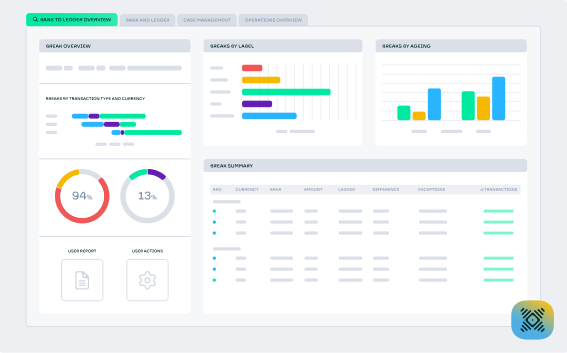
  5. Provide operational dashboards, reconciliation status, settlement and balance visibility, and scheduled outputs for finance, operations and oversight. Drill-down reporting connects summary positions to the underlying records and exceptions.

  6. Maintain controlled workflows for ownership, commentary, review, and sign-off. Record user actions and resolution evidence so teams can demonstrate how reconciliations were completed and how exceptions were managed.

What this replaces

  • Manual spreadsheet matching

    Replace time-consuming spreadsheet matching and manually reformatted files with automated processes that standardize data and reduce operational effort across growing payment volumes.

  • Fragmented tools and workflows

    Consolidate disconnected point solutions and email-based exception handling into one controlled workflow, improving visibility, accountability and collaboration throughout the reconciliation process.

  • Costly in-house development

    Reduce reliance on custom-built processes that require constant development as payment rails, counterparties, transaction volumes and source file structures continue to evolve.

Reconcile every stage of the payment lifecycle

Bring greater intelligence to every payment exception

Established payment automation, strengthened by embedded intelligence that helps teams understand and act on exceptions.

  • Smarter matching

    Learns from user interactions to suggest likely matches across transaction, settlement, fee, and balance records where timing, rounding, foreign exchange, or reference differences prevent straightforward matching.

  • Intelligent exception support

    Uses available reconciliation context to help categorize and prioritize unmatched or out-of-tolerance items across processors, acquirers, schemes, bank accounts, and internal records.

  • Anomaly and pattern identification

    Analyzes payment and settlement data to highlight unusual patterns and help explain anomalies across feeds with different structures and frequencies.

  • Intelligent guidance

    Provides context-aware assistance for configuration questions, investigation steps, and workflow activity within the established payments reconciliation process.

  • Manager oversight

    Provides visibility into reconciliation status, schedules, workflows, and exceptions across real-time, intraday, and batch processing cycles.

Bring fragmented payment data into one reconciliation control

AutoRek ingests payment data from any source and format, without pre-formatting or IT involvement.

  • Internal Sources

    Internal payment ledgers, general ledger and sub-ledger records, customer and merchant account records, treasury and liquidity records, internal transaction platforms, fee tables, dispute, refund and chargeback records, operational reference data.

  • External Sources

    Payment gateways, processors, acquirers, issuers, card networks and schemes, sponsor banks, settlement and safeguarded bank accounts, clearing networks, custodial partners, alternative payment providers.

  • Supporting Data Sources

    FX rates, fee and interchange schedules, merchant and customer master data, calendars and cut-off data, reference and mapping tables, reason codes, chart of accounts data.

  • Supported Formats

    AutoRek can ingest data from virtually any source, including CSV, Excel, XML, JSON, SWIFT, ISO 20022, BAI/BAI2, APIs, databases, cloud platforms and proprietary file formats.

Payment reconciliation built for complex financial ecosystems

Related Use Cases

Insights for financial operations and control

Research, guides and updates on the operational and regulatory challenges facing regulated firms.

Frequently asked questions

Payments reconciliation is the process of comparing transaction, clearing, settlement, fee, bank and ledger records to confirm each payment is accurately recorded and discrepancies are identified.

Bring every payment reconciliation into one controlled view

See how AutoRek can connect payment, processor, scheme, bank and ledger data, automate repeatable matching and give operations teams a clear route from exception to resolution and sign-off.

Book a demo