






Skip to content

Automated intercompany reconciliation software

Remove intercompany reconciliations from the critical path of financial close. AutoRek brings together summary balances and transactional detail from group-wide systems, validates and enriches records, matches counterparties, routes exceptions for resolution, supports adjustment output, and provides reporting and sign-off through a controlled workflow.

Intercompany breaks should not hold up 
the close

Understand why intercompany reconciliation can become a close bottleneck when balances, counterparties, supporting transactions and exceptions are managed across fragmented systems and manual processes.

Operational Challenges

Balances may be owned across many entities, divisions and teams. Disposals, acquisitions, mergers, entity changes and reorganizations can make counterparty control difficult. Period-end posting and infrequent cash settlement can leave limited time to agree positions before consolidation.

Accounting and Consolidation Challenges

Intercompany balances need to be eliminated on consolidation. Net balances can be difficult to connect to debtor and creditor components, activity may be posted to sundry accounts, and transfer-pricing entries may only be calculated at period end.

Data Challenges

Balances can be aggregated in ledgers, unsupported by sub-ledgers, recorded in different currencies or missing a settled flag. One-sided relationships, or “orphans”, and unexploded bulk items reduce the detail available for matching and analysis.

Governance Challenges

Ownership may be treated as a central or group issue rather than a responsibility shared with divisions. Unclear escalation, inconsistent policies and incomplete evidence make it harder to resolve disputes, monitor exposure and prove that controls operated consistently.

From group data to controlled intercompany sign-off

  1. Bring together intercompany opening and closing balances, transactional detail, general-ledger and sub-ledger records, counterparty data, exchange rates and relevant adjustment data from ERP and line-of-business systems.

  2. Check that each transaction or balance is fully accounted for, supported by primary accounting records and prepared for reconciliation. Identify missing records, unexploded bulk items and integrity issues before matching.

  3. Disaggregate data to the lowest practical level of granularity, enrich records, map counterparty relationships and match balances or transactions across entities. Relationships in agreement can be separated from higher risk records which disagree and any identified orphan positions.

  4. Categorize and prioritize unmatched items, one-sided relationships, opening-balance errors, period movements and out-of-range accounts. Route issues to the appropriate owners using case management and escalation workflows.

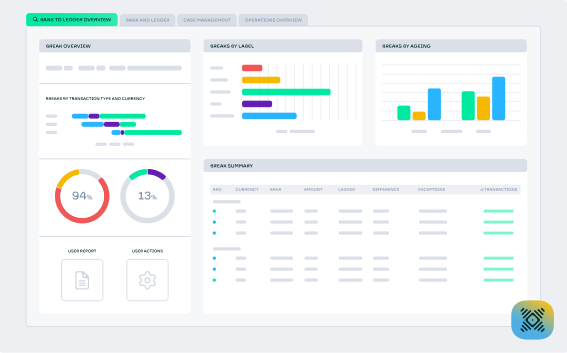
  5. Provide reconciliation status, exposure, matched and unmatched item analysis, data-completeness measures and management information by year, division, entity or relationship. Support adjustment output to ERP systems as part of a scheduled process.

  6. Apply rules, permissions, tolerances, timetables, sign-off and approval. Maintain traceability across source records, matching, investigation, adjustments and attestation, while using KPIs to focus remediation on high-risk relationships.

What this replaces

  • Spreadsheet-based balance comparisons

    Manual balance checks are replaced with a repeatable matching process that connects intercompany records across entities and systems.

  • Disconnected counterparty chasing

    Informal follow-ups are replaced with structured ownership, routing and escalation for unresolved intercompany differences.

  • Uncontrolled exception logs

    Static trackers are replaced with governed exception management that records status, actions, commentary and evidence.

Controls built around the intercompany workflow

Strengthen intercompany matching, investigation, and oversight.

Established intercompany controls, strengthened by embedded intelligence that helps teams understand and prioritize what needs attention.

  • Smarter matching

    Learns from user interactions to suggest likely matches across mapped counterparties, balances, and transaction-level records.

  • Anomaly and pattern identification

    Analyzes intercompany records to highlight unusual movements, one-sided relationships, unsupported balances, or recurring break patterns.

  • Exception prioritization

    Supports the categorization and prioritization of disagreed balances, orphans, opening-balance errors, and out-of-range accounts.

  • Intelligent guidance

    Provides context-aware assistance for users investigating exceptions, applying workflow steps, or navigating configuration and control processes.

  • Manager oversight

    Provides visibility into reconciliation status, schedules, workflows, and exceptions across entities, divisions, or relationships.

Bring the intercompany record together

Consolidate the balances, transactions, reference data and settlement records needed to support accurate intercompany matching, investigation and sign-off.

  • Internal Sources

    Opening and closing intercompany balances, general-ledger accounts, accounts payable and receivable records, transaction detail, sub-ledger records, transfer-pricing adjustments and recharges, cash-settlement records, legal-entity and division records.

  • External Sources

    Bank statement data can be consumed to provide confirmation of transactional movement and settlement.

  • Supporting Data Sources

    Counterparty mappings, entity hierarchies, centrally set exchange rates, account mappings, ownership data, reconciliation policies, tolerances, exception categories, sign-off and escalation records.

  • Supported Formats

    AutoRek can ingest data from virtually any source, including CSV, Excel, XML, JSON, SWIFT, ISO 20022, BAI/BAI2, APIs, databases, cloud platforms and proprietary file formats.

Intercompany control across complex groups

Related Use Cases

Insights for financial operations and control

Explore related reconciliation resources, market insights and practical guidance to support stronger intercompany control.

Frequently asked questions

Intercompany reconciliation checks that balances and transactions recorded between companies in the same group agree, so the corresponding positions can be eliminated during consolidation.

Take intercompany reconciliations off the critical path

See how AutoRek can bring group data, counterparty matching, exceptions, adjustment output, reporting and sign-off into one governed workflow, built around your entity structure, systems and close process.

Book a demo