Skip to content

Automated accounts payable and accounts receivable reconciliation software

Keep supplier liabilities, customer receivables and general ledger balances aligned. AutoRek brings invoices, payments, credits, statements and control accounts into one governed process, helping finance teams identify discrepancies, investigate exceptions and maintain clear evidence for review and sign-off.

Payables and receivables need a single version of financial truth

AP and AR sit on opposite sides of working capital, but both depend on complete, consistent records. Supplier invoices, purchase orders, receipts, payments, customer invoices, cash receipts and credits may be held across different systems.

If external statements and GL control accounts do not agree, teams can carry inaccurate liabilities or receivables into reporting, payment, collection, and close processes.

Operational Challenges

Finance teams collect documents, compare balances and maintain exception logs across suppliers, customers and accounting periods. Manual work can delay payment, collection and close activity.

Regulatory Challenges

Organizations need accurate records and evidence that reconciliations were prepared, reviewed and approved.

Data Challenges

Invoices, purchase orders, goods receipts, payment records, credit memos, statements, and GL balances can be incomplete, duplicated, mistimed or recorded under inconsistent references.


Governance Challenges

Unclear ownership, unsupported adjustments, weak cut-off control and inconsistent sign-off make it harder to evidence how differences were identified, corrected and approved.

From source documents to controlled AP and AR sign-off

  1. Bring together AP and AR sources, GL control accounts, vendor and customer statements, invoices, purchase orders, receiving records, payment and receipt data, credit memos and approved reference data.

  2. Check source completeness, cut-off dates, duplicates, missing records and field consistency. Standardize supplier, customer, invoice, payment and account references before matching.

  3. Match AP sources totals to the GL and vendor statements, and AR sources totals to the GL and customer-level records. Apply invoice, payment, credit and balance matching according to the approved operating model.

  4. Identify duplicate or missed payments, unapplied payments or cash, unrecorded invoices, missing credits, timing differences, disputed items, unauthorised write-offs and other exceptions. Route items with supporting evidence.

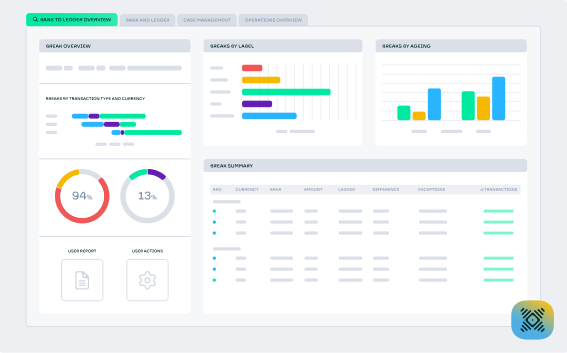
  5. Provide reconciliation status, open-item, aged balance, exception and sign-off views for finance, treasury, collections, payment operations and audit.

  6. Apply role-based ownership, review, approval, commentary and evidence retention. Maintain traceability from source record through matching, correction and sign-off.

What this replaces

  • Spreadsheet comparisons

    Comparing supplier and customer balances across spreadsheets is time-consuming and 
prone to error.

  • Manual statement ticking

    Manually matching invoices, payments and statements slows reconciliation and exception identification.

  • Sign-off processes that are difficult to evidence

    Spreadsheet and email-based approvals can make audit trails difficult to demonstrate.

Controls across payables, receivables and the general ledger

Stronger intelligence across payable and receivable controls

Established AP and AR automation, strengthened by embedded intelligence that helps teams focus on the exceptions that need human judgment.

  • Smarter matching

    Uses patterns in approved user actions to suggest likely matches across invoices, payments, receipts, credits, statements, subledgers, and GL control accounts.

  • Anomaly and pattern identification

    Analyzes AP and AR records for unusual patterns linked to potential duplicates, missing items, timing differences, or inconsistent references.

  • Intelligent exception support

    Provides context to support the categorization and prioritization of unapplied cash, unmatched payments, disputed invoices, missing credits, and other breaks.

  • Manager oversight

    Provides visibility into reconciliation status, schedules, workflows, open exceptions, and sign-off activity across payable and receivable controls.

  • Intelligent guidance

    Surfaces context-aware assistance for configuration, investigation, and governed workflow steps within the platform.

Connect the records behind every payable and receivable balance

Ingest, standardize and reconcile data from virtually any source to improve visibility, accuracy and control.

  • Internal Sources

    AP and AR sources; GL control accounts; vendor and customer master data; invoice registers; purchase orders; receiving records; payment runs; cash receipts; credit memos; write-offs; aged creditor and debtor reports.

  • External Sources

    Vendor statements; customer remittance information; bank statements and payment confirmations; payment processor or collection records where relevant.

  • Supporting Data Sources

    Account mappings; supplier and customer identifiers; payment terms; currencies and FX rates; cut-off calendars; exception categories; approval rules; dispute and collection status.

  • Supported Formats

    AutoRek can ingest data from virtually any source, including CSV, Excel, XML, JSON, SWIFT, ISO 20022, BAI/BAI2, APIs, databases, cloud platforms and proprietary file formats.

AP and AR reconciliation across
complex finance operations

Related Use Cases

Insights for AP & AR reconciliations

Research, guides and updates on the operational and regulatory challenges facing regulated firms.

Frequently asked questions

They support accurate balances, cash flow management, discrepancy detection, review evidence and audit readiness.

Bring payables, receivables and ledger control into one workflow.

See how AutoRek can connect supplier, customer, invoice, payment, statement, sources and GL records, automate matching, route genuine exceptions and provide clear evidence for review and sign-off.

Book a demo